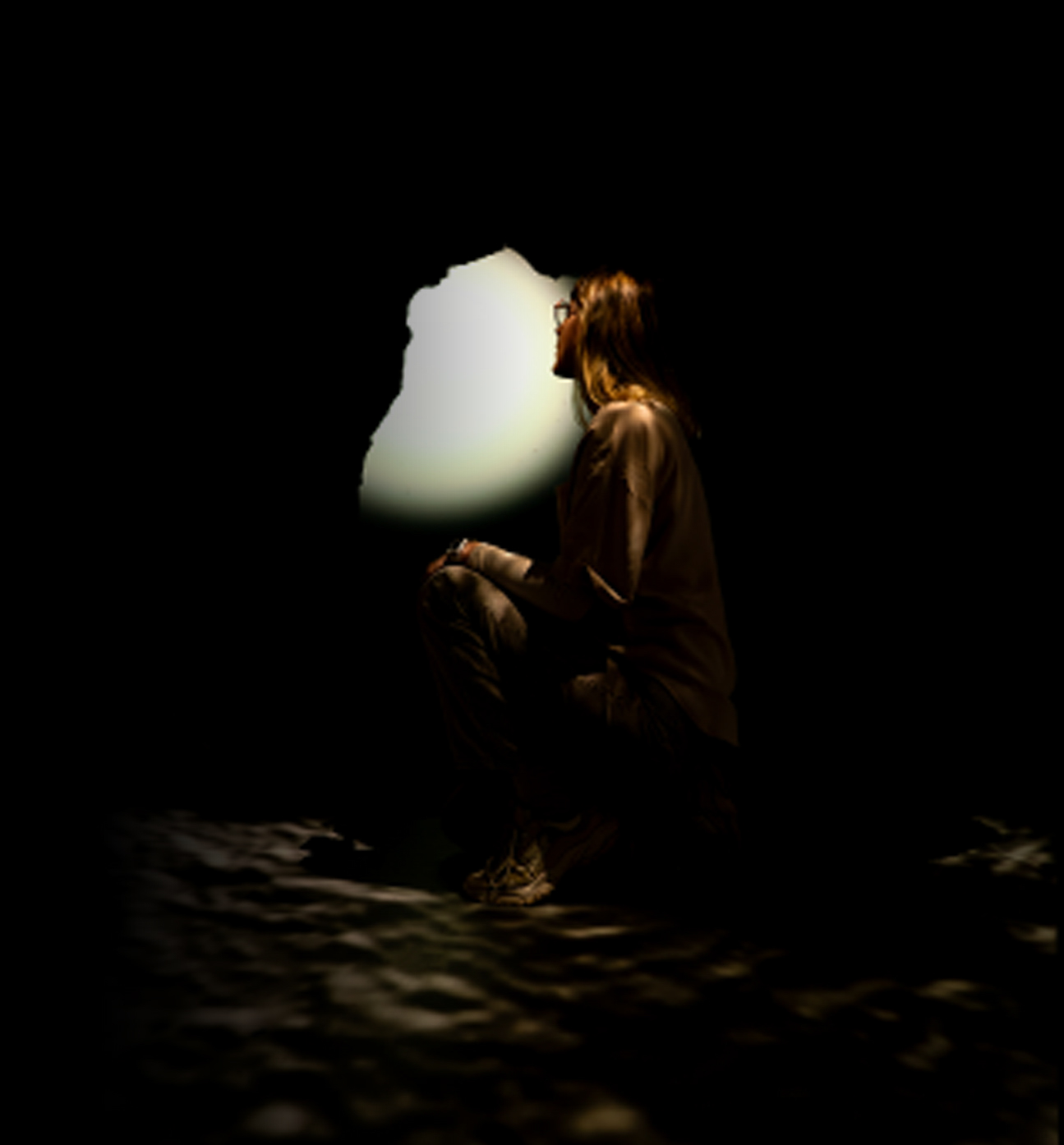
Plato’s Cave is an immersive installation that
reimagines the ancient allegory as a sensory
encounter with perception itself. At the far end of a
dimly lit room stands a cave-like structure, its
entrance glowing with an ambiguous light. As
visitors approach and enter, they cross a threshold
between the seen and the hidden.
A concealed sensor captures a real-time point
cloud of each participant’s body,
rendering their silhouettes into shifting, exaggerated
shadows that are cast across the surrounding walls
and floor. These projections distort and stretch the
human form, creating a haunting mirror—grotesque
echoes of reality flickering in
the darkness.
The work draws directly from Plato’s Allegory of the
Cave, a foundational philosophical parable from The
Republic. In the story, prisoners are chained inside a
cave, facing a blank wall. Behind them, a fire burns,
and objects pass in front of it, casting shadows on
the wall. The prisoners, unable to turn around, believe
these shadows are reality—unaware of the true world
outside. Only when one prisoner escapes does he
realize the depth of the illusion—and the painful
process of awakening to truth.
Plato’s Cave invites us to reflect on our own
perceptions—how we filter, distort, and project
reality based on limited inputs. Are we still watching
shadows? And what happens when we dare to
turn toward the light?
“How could they see anything but the shadows
if they were never allowed to move their heads?”
— Plato, The Republic